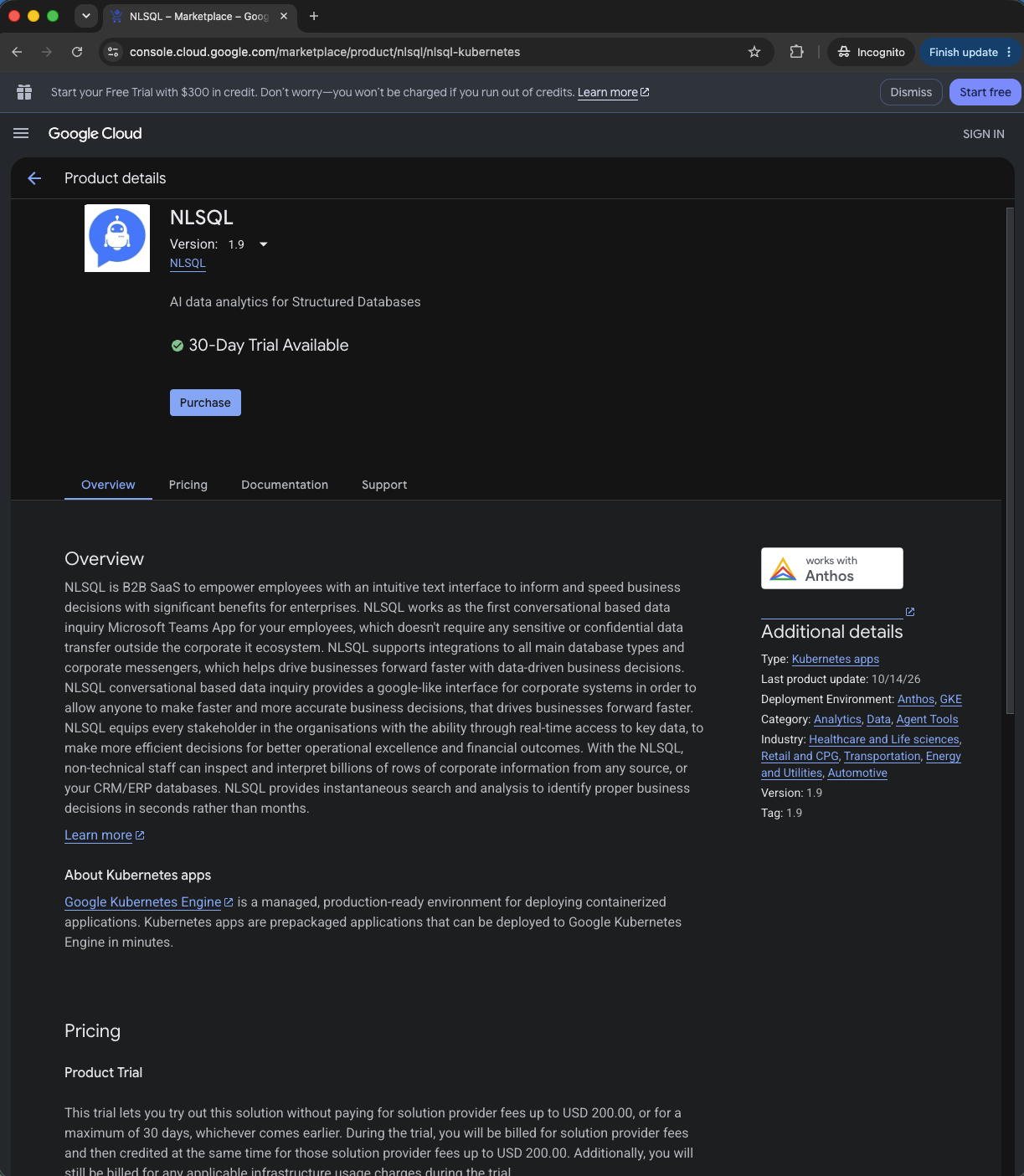
NLSQL Is Now Available on Google Cloud Marketplace
NLSQL is now available on Google Cloud Marketplace, giving organisations another way to discover and deploy AI-powered analytics for enterprise databases through Google's cloud software ecosystem.
NLSQL enables business users to ask questions about company data in plain English and receive database-driven answers without having to write SQL queries manually. By connecting conversational AI with enterprise data, NLSQL helps teams access business insights more independently and reduce their reliance on technical teams for routine analytics requests.
With its Google Cloud Marketplace Kubernetes listing, NLSQL extends its availability to organisations looking to deploy software through the Google Cloud ecosystem.
What Is NLSQL?
NLSQL is an enterprise AI data analytics platform that translates business questions into database queries and returns results that users can understand and act on.
Traditionally, employees who need information from business databases must understand SQL, use predefined dashboards or ask data analysts to prepare reports. These workflows can slow down decision-making and create repetitive work for data teams.
NLSQL makes database analytics more accessible by allowing users to interact with enterprise data through natural-language questions.
For example, a user could ask:
"Which products generated the most revenue last quarter?"
"How have sales changed compared with the previous month?"
"Which customers contributed the most to our revenue?"
"What are the key trends in our sales performance?"
NLSQL translates supported questions into SQL, queries the connected database and returns results based on the available data and configured business logic.
The goal is to make enterprise analytics accessible to more employees while keeping answers grounded in the organisation's underlying data.
Use Cases for NLSQL on Google Cloud
1. Sales and Revenue Analytics
Sales teams can ask questions about revenue, customer performance, product sales and changes over time, using the information available in their connected databases.
2. Business Intelligence and Reporting
Business analysts and managers can investigate operational metrics, validate business questions and retrieve data for reports and presentations.
3. Operations and Supply Chain
Operations teams can explore inventory, order volumes, delivery performance and other operational indicators where the relevant data is available.
4. Finance and Management Reporting
Finance and management teams can ask questions about financial performance and business KPIs, subject to the configured database schema, metric definitions and access permissions.
Across these use cases, the objective is to reduce the distance between asking a business question and obtaining the data needed to answer it.
More:
Deploy NLSQL to GCP now